


Founded in Australia, the client is an advanced technology manufacturer that has scaled rapidly in response to growing global demand. Its customers also span a diverse range of industries globally.
Their systems are deployed in complex and regulated environments, as well as large-scale operational settings where reliability is essential. In these contexts, reliability, traceability and compliance are not simply operational preferences, but fundamental to maintaining consistent and effective operations.
Opportunity
A growing focus on advanced capability
Advanced technologies are reshaping operational environments and introducing new areas of risk. In response, organisations are changing their approach to procurement and there is now a growing emphasis on controlled, in-country manufacturing capability.
This shift has been reflected through public sector priorities and policy direction, highlighting the importance of resilient, locally supported technology ecosystems.
These changes are also reflected in the dynamics of the market where the client operates.
This market includes large global providers, specialised vendors and emerging technology companies. The client differentiates themselves through a focused offering that integrates advanced software with proprietary hardware and local manufacturing capability, positioning it strongly within structured procurement environments.
The client also participates in formal procurement frameworks, supporting delivery into regulated operational settings.
The inevitable revenue surge
Within this period of structural acceleration, the client’s growth shifted from incremental to exponential.
Over a single financial year, revenue increased severalfold, supported by a substantial global pipeline and strong forward order coverage. Demand translated into execution, with the client securing its largest contracts to date and expanding into new markets.
To meet this demand, production capacity scaled significantly, supported by an expanded manufacturing footprint across multiple regions. Workforce numbers increased materially within a short period to support this growth.
This expansion brought heightened scrutiny and increased expectations around governance, reporting and operational control.
Rising scale, rising risk
By the end of FY2025, the client had transitioned from a high-growth innovator to a global manufacturer operating in highly regulated, compliance-driven and operationally critical markets.
With that transition came three structural imperatives:
1. Governance at public-market scale
As a technology company operating across regulated and data-sensitive environments, the client required enterprise-grade auditability, traceability and financial control across jurisdictions. Investors, regulators and customers expect disciplined reporting, clear oversight and demonstrable compliance. Governance capability needed to scale in parallel with market expectations.
2. Operational alignment to accelerated growth
Revenue acceleration, expanding manufacturing capacity and increasing contract complexity introduced tighter interdependencies across demand forecasting, supply chain management, production planning and financial reporting. What had previously operated effectively within a smaller footprint now required enterprise-wide integration to sustain delivery at scale.
3. Reporting confidence under scrutiny
Heightened stakeholder attention and expanding global operations required reliable, auditable data across entities and geographies. Forecasting accuracy, production visibility and cost control became central not only to performance management, but to maintaining stakeholder trust.
These were not technology shortcomings. They were structural risks emerging at scale.
The operating model needed to evolve from high-growth practices to institutional-grade governance without slowing commercial momentum.
Far from being just optimisation, transformation was, essentially, a strategic necessity.
Solution
Recognising the structural importance of the transformation, the client undertook a competitive evaluation involving Tier-1 global integrators and specialist providers.
NRI distinguished itself in four critical ways:
1. Deep understanding of large-scale manufacturing
NRI demonstrated a clear understanding of the client’s manufacturing scale-up trajectory and the compliance realities of operating within regulated environments. The transformation was positioned to support production expansion and cross-border operations – not merely system consolidation.
2. Executive alignment and delivery responsiveness
Senior NRI leadership engaged directly with Finance, Operations, Sales and Executive stakeholders, establishing business alignment from day one. Transparent commercials, pragmatic timelines and disciplined scope design reinforced execution realism. Rapid turnaround of solution refinements and commercial clarifications created confidence in how the team would operate under delivery pressure.
3. Integrated architecture supporting end-to-end control
NRI presented a fully connected and secure Salesforce and Oracle Fusion Cloud Applications architecture designed across the entire Lead-to-Cash lifecycle: from opportunity management to supply chain, manufacturing and financial reporting. The proposal avoided modular deployment in favour of structural integration aligned to international growth.
4. Embedded vendor governance and shared accountability
The program operated under a three-way executive partnership model: the client retained clear business ownership, NRI provided accountable delivery leadership, and Oracle and Salesforce played distinct but complementary strategic roles.
Salesforce was actively involved alongside NRI during early scoping and solution design, shaping the commercial and Lead-to-Cash architecture from the outset. This front-loaded collaboration ensured opportunity management, forecasting and CPQ were aligned to the client’s growth trajectory.
Oracle was engaged as a coordinated partner from program inception and embedded within the Steering Committee, reinforcing aligned solution governance, optimised licensing structures, clear escalation pathways and visible executive sponsorship.
Together, this model ensured that both the commercial front-end and enterprise core were architected as a unified operating model. The outcome was collective ownership of delivery, materially reduced implementation and post-go-live risk, and sustained alignment to evolving regulatory requirements. What began as a competitive evaluation evolved into a genuine executive partnership grounded in transparency, responsiveness and enterprise-level accountability.
Building the operating core for execution at scale
With partnership established, the focus shifted to execution at scale.
The transformation was designed not as system replacement, but as an organisational maturity program, embedding governance, traceability and real-time visibility across the client’s end-to-end operating model.
Program size and delivery footprint
At peak, the program operated with more than 30 full-time equivalents across the NRI, client and vendor teams. Oracle Fusion Cloud Applications were implemented over approximately 10 months, with Salesforce deployed in parallel over a six-month period.
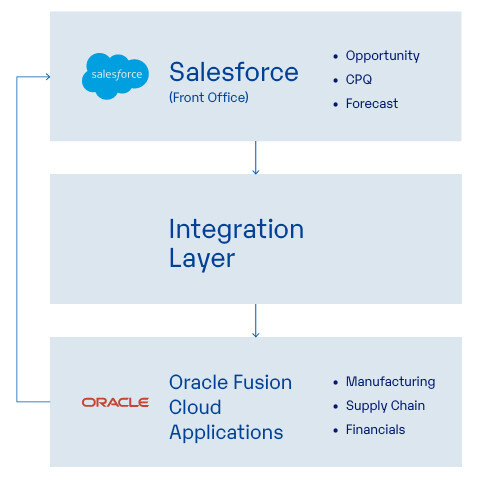
The Oracle Fusion Cloud Applications footprint included Financial Management, Project Portfolio Management, Order Management, Planning, Inventory Management, Manufacturing, Maintenance and Sales – all integrated across multiple entities and geographies. Salesforce was introduced as the strategic front-end customer enablement platform, providing full sales lifecycle management from opportunity identification to sales order. The sales enablement platform is tightly coupled to Oracle Fusion Cloud Applications and integrated with various third-party systems, such as tax services, and supports operational and reporting workflows through Tableau.
Together, Salesforce and Oracle Cloud Fusion Applications form a fully integrated enterprise architecture supporting the organisation end-to-end, from opportunity identification and quoting through manufacturing, fulfilment, financial control and ongoing service support. Commercial intent, operational execution and aftercare now operate within a single governed ecosystem rather than disconnected workflows.
Integrated Lead-to-Cash Operating Model
The combined program compressed what is typically a multi-year enterprise transformation (often more than two years for similar scope) into approximately 12 months of active delivery.
This acceleration was enabled by disciplined scope control, executive sponsorship and a collaborative decision-making model that allowed rapid design refinement and issue resolution.
Governance-led acceleration
The program combined PRINCE2 governance discipline with Oracle’s True Cloud methodology, alongside parallel agile-led Salesforce development and deployment. ERP, CRM and supply chain capabilities were introduced simultaneously rather than sequentially, enabling integrated capability uplift without elongating the timeline.
Key design principles included:
• Adopting industry leading practices over excessive customisation
• Embedding governance and traceability by design
• Delivering enterprise capability at start-up pace
• Prioritising real-time operational visibility
Pragmatic change enablement
Given the organisation’s size and pace, traditional large-enterprise change frameworks were unsuitable. Instead, NRI and the client adopted an embedded collaboration model:
• Direct end-user involvement in design
• Intensive hands-on training
• Rapid feedback loops
• CFO-led engagement with users
This approach supported adoption while maintaining delivery speed. The focus was on enabling operational behaviours rather than documentation-heavy change processes.
Organisational response to the new platform was overwhelmingly constructive. Teams recognised early the benefits of structured workflows, integrated reporting and improved visibility. This openness to new ways of working materially reduced change friction, which is understandably a critical factor in a program of this scale and pace.
The reality of delivering results in a changing environment
Understandably, transforming a rapidly scaling technology manufacturer is not a static exercise.
The client’s operating model continued evolving throughout design and build. Manufacturing capacity was expanding. Contract structures were increasing in size and complexity. Regulatory considerations shifted as new markets were entered. Establishing a stable enterprise core while the business itself was accelerating required architectural discipline and executive clarity.
Baseline processes were not fixed at program commencement. As commercial and operational realities evolved, scope refinements became necessary. Rather than allowing volatility to erode structural integrity, NRI introduced controlled decision gates and rapid design cycles. Scope changes were evaluated against long-term operating maturity, not short-term convenience.
Delivery complexity was further heightened by strict regulatory and data governance requirements. Resource allocation was limited to approved personnel pools, constraining staffing flexibility and requiring proactive sequencing of workstreams. NRI adjusted resource planning and prioritisation models to maintain momentum without compromising compliance.
Parallel ERP and CRM deployment increased integration interdependencies. Dependencies across finance, manufacturing, supply chain and opportunity management required coordinated escalation and disciplined governance. Vendor representation embedded within Steering Committee forums enabled immediate issue resolution and protected delivery cadence.
Although execution extended modestly beyond the original timeline, this was a consequence of strengthening the operating model amid ongoing business evolution, and not a loss of control. Close collaboration between the client’s executive team and NRI delivery leadership enabled rapid decision-making, accelerated approvals and clear trade-off management.
The program was not frictionless. But importantly, it was resilient.
Outcomes
The value of transformation is measured not always in systems
deployed, but in capability institutionalised. For the client, that
capability shift is already visible across operations, governance and market credibility.
Immediate enterprise impact
As the solution has recently gone live, formal performance metrics are still emerging. However, observable outcomes already demonstrate operational transformation.
Enterprise data is now consolidated across entities, eliminating fragmented reporting and reducing reliance on spreadsheet-driven reconciliation. Financial consolidation cycles have accelerated, supported by system-enforced controls rather than manual verification. Leadership teams operate from a single, integrated source of operational and financial truth.
Manufacturing visibility has materially improved. Production output, inventory position and cost performance are aligned in real time with commercial commitments and revenue impact. Demand forecasting now informs procurement and capacity planning through governed workflows rather than informal coordination.
Opportunity management and quoting are standardised through Salesforce, strengthening pipeline discipline and supporting execution of increasingly complex contracts across the global marketplace. Month-on-month and year-to-date pipeline management and forecasting are provided by intuitive dashboards and self-servicing via Tableau. Lead-to-Cash integration ensures commercial decisions translate directly into operational accountability.
Decision-making cycles have compressed. Cross-functional interdependencies that once required reconciliation are now synchronised within a unified architecture.
The client now operates on enterprise-grade processes aligned to its growth trajectory and regulatory obligations. The organisation has transitioned from managing rapid expansion through oversight to governing it through integrated control.
Strategic business impact
For the client, this transformation has fundamentally reshaped the organisation’s risk profile.
The integration of Salesforce and Oracle established a closed-loop operating model in which commercial demand, production planning and financial performance are structurally synchronised. Forecasted opportunities now drive procurement and capacity planning in real time, ensuring growth is both executable and governance-aligned.
Under increasing scrutiny, reporting confidence is no longer dependent on reconciliation effort but embedded control. Shareholder transparency is system-enforced. Expansion into new jurisdictions no longer requires replicating fragmented processes. Procurement bodies engage with an enterprise whose operational maturity matches the strategic importance of its capability.
This is more than efficiency. It is structural credibility.
Contract execution now rests on integrated discipline rather than coordination. Pipeline growth aligns to manufacturing capacity. Financial visibility underpins investor confidence.
The client has transitioned from overseeing rapid growth to governing it through enterprise control.
That shift is foundational to sustaining accountability at scale.

Related case studies



Ready to think ahead?

Get Notified
Want to keep up to date with our latest news, media, or insights? Subscribe below.